Episode: 1 - Jack The Ripper
Who was Jack the Ripper?
 Jack the Reaper is a famous well know murderer of the history. The strange thing is that he only had 5 victims which is not a lot compared to other serial killer. Then what made Jack the Reaper famous? A part was appeal that the police never found him. The forensics of 1988 was also not developed enough to investigate the case.
It was
believed that he was active mainly around the Whitechappel district of
London in 1888. Jack the Ripper was typically involved in female
prostitutes who lived and worked in the slums of the East End of London
whose throats were cut prior to abdominal mutilations. Many thinks that he was a doctor with some surgical knowledge as three of his victims had internal organs removed.
The
name "Jack the Ripper" originated in a letter written by someone
claiming to be the murderer that was spread in the media.


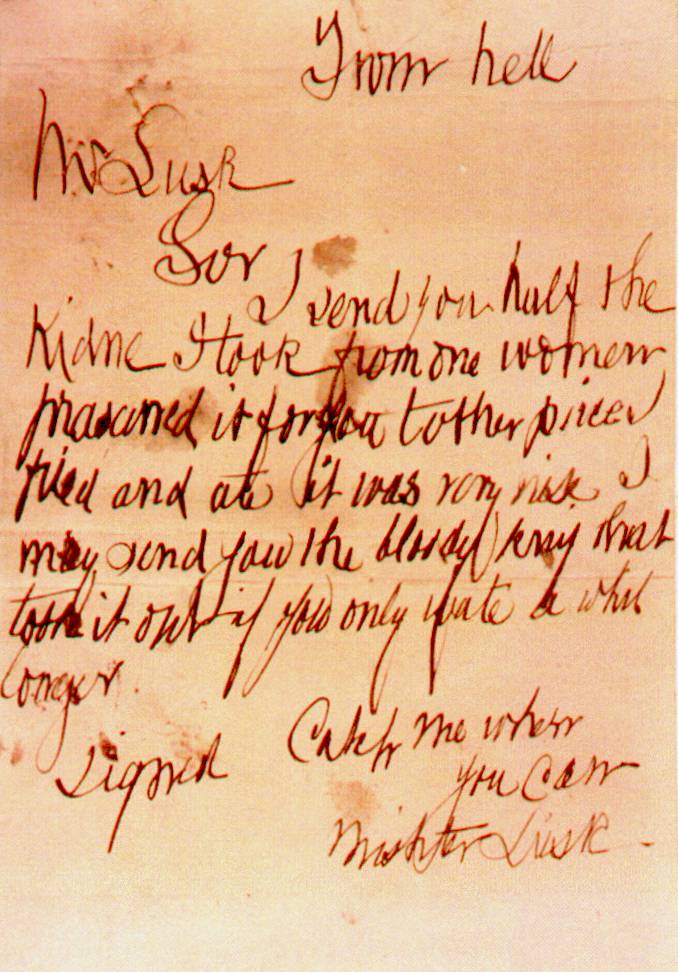
"From hell
- Mr Lusk
- Sir
- I send you half the Kidney I took from one women preserved it for you hotter pierce I fried and ate it was very nice I may send you the bloody knife that took it out if you only wait a while longer.
- signed Catch me when
- you Can
- Mishter Lusk."
Victims:
His famous victims are Mary Ann Nichols, Annie Chapman, Elizabeth Stride, Catherine Eddowes, and Mary Jane Kelly.
Mary Ann Nichols' body was discovered at about 3:40 a.m. on Friday 31 August 1888 in Buck's Row (now Durward Street),
Whitechapel. The throat was severed by two cuts, and the lower part of
the abdomen was partly ripped open by a deep, jagged wound. Several
other incisions on the abdomen were caused by the same knife.

Annie Chapman's body was discovered at about 6 a.m. on Saturday 8 September 1888 near a doorway in the back yard of 29 Hanbury Street, Spitalfields. As in the case of Mary Ann Nichols, the throat was severed by two cuts. The abdomen was slashed entirely open, and it was later discovered that the uterus had been removed. At the inquest, one witness described seeing Chapman at about 5:30 a.m. with a dark-haired man of "shabby-genteel" appearance.


Eddowes' body (right) was found in Mitre Square in the City of London,
three-quarters of an hour after Stride's. The throat was severed and
the abdomen was ripped open by a long, deep, jagged wound. The left
kidney and the major part of the uterus had been removed.
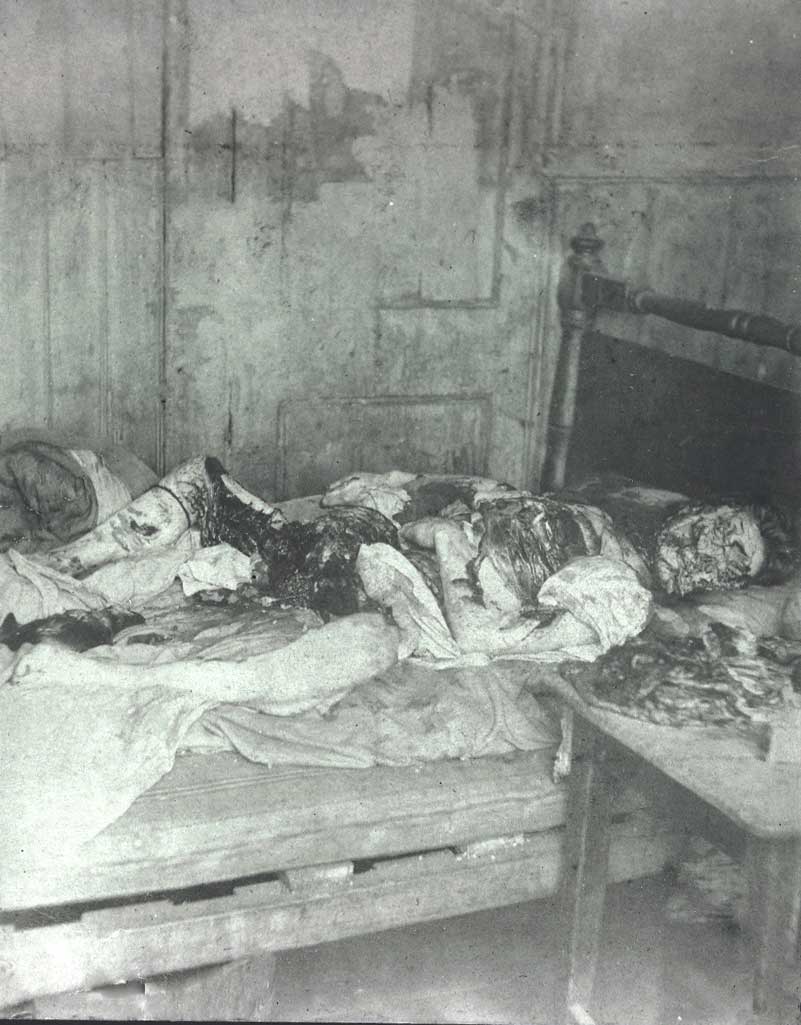
Mary Jane Kelly's mutilated and disemboweled body was discovered lying on the bed in the single room where she lived at 13 Miller's Court, off Dorset Street, Spitalfields, at 10:45 a.m. on Friday 9 November 1888. The throat had been severed down to the spine, and the abdomen almost emptied of its organs. The heart was missing.

Investigation:
All five murders no doubt were committed by the same hand. In the first
four the throats appear to have been cut from left to right, in the last
case owing to the extensive mutilation it is impossible to say in what
direction the fatal cut was made, but arterial blood was found on the
wall in splashes close to where the woman's head must have been lying.
All the circumstances surrounding the murders lead to form the
opinion that the women must have been lying down when murdered and in
every case the throat was first cut.
The
police conducted house-to-house inquiries throughout Whitechapel.
Forensic
material was collected and examined. Suspects were identified, traced,
and either examined more closely or eliminated from the inquiry. More
than 2,000 people were interviewed, "upwards of 300" people were
investigated, and 80 people were detained.
Investigation was continued for months and years, however, the forensics was not developed enough that time to solve the case. Police never was able to identify the murderer. No one was ever able to know who was he. Jack the Reaper came and disappeared like a ghost.
Investigation was continued for months and years, however, the forensics was not developed enough that time to solve the case. Police never was able to identify the murderer. No one was ever able to know who was he. Jack the Reaper came and disappeared like a ghost.
Comments
Post a Comment